

Market Insight #27: Accelerating the DCA
Hello everyone, and welcome to this week’s market insight.
Portfolio Update:
I bought roughly $2,800 worth of Bitcoin this week, bringing the portfolio to 50% Bitcoin. The plan is still to continue buying spot Bitcoin through the DCA process. This is now purchase 6 out of 20. The difference is that I have accelerated the allocation. Instead of continuing with 5% weekly buys until reaching 50%, I moved there now. From here, I am reducing the weekly DCA from 5% to 2.5% so the buying plan can still run into October.
Date | Bitcoin Price | Amount Invested | BTC Bought |
|---|---|---|---|
08.06.26 | $62,970 | $469 | 0.007512 |
15.06.26 | $65,829 | $470 | 0.00714 |
22.06.26 | $64.162 | $470 | 0.007325 |
29.06.26 | $60,485 | $470 | 0.007771 |
06.07.26 | $63,000 | $470 | 0.00746 |
13.07.26 | $62,741 | $2,382 | 0.003796 |
Market Update:
My Bitcoin bottom indicator flashed a buy signal this week, suggesting a potential reversal in price. This is not something I want to overstate. The indicator only has one major historical bear market signal, so it does not have enough data to rely on by itself, but it has shown a good track record in other markets. It did also identify the last major bottom around $16k before Bitcoin later moved much higher.
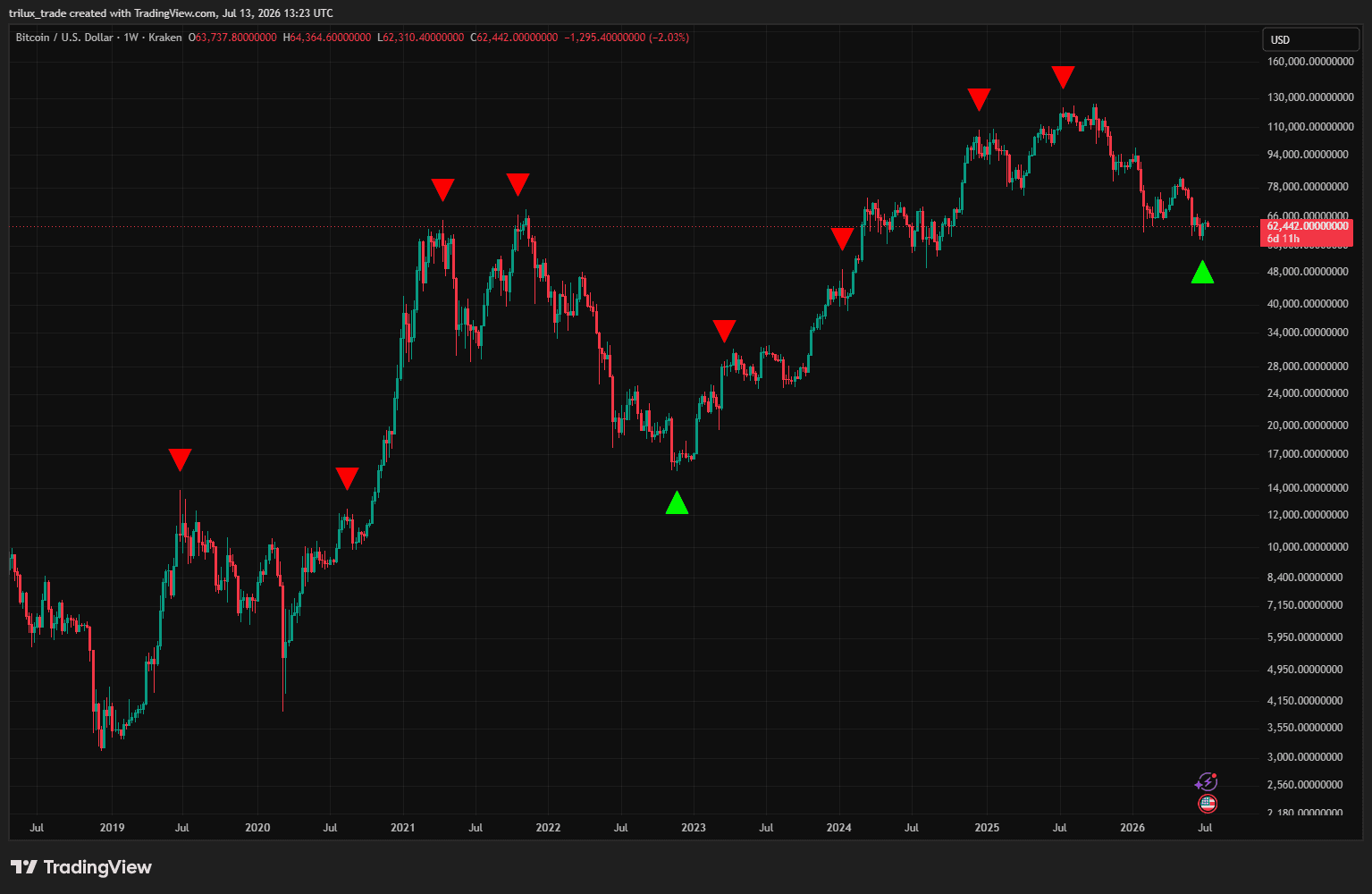
On its own, that would not be enough for me to make a large change. But this signal now lines up with many of the factors discussed over the past few months: compressed valuation ratios, on-chain bottoming models clustering near the same value zone, a large share of holders underwater, and cycle timing moving closer to the historical bottoming window. That combination is what pushed me to accelerate the portfolio to 50% Bitcoin.
To be clear, this is not a call that the exact bottom is in. Bitcoin can still move lower. But the risk-reward has improved enough for me to increase exposure now instead of waiting another four weeks to reach the same allocation. From here, the plan is simple. The portfolio is now 50% Bitcoin. The DCA continues at 2.5% per week. If price moves lower, the remaining cash buys at better prices. If price moves higher, the portfolio already has meaningful exposure.
Education of the Week: Position Sizing After a Buy Signal
A buy signal does not mean there is only one way to act. It only means conditions have improved. The next question is position sizing. How much exposure makes sense now, and how much should be kept for later?
There are a few ways to approach this:
The most aggressive approach is full allocation. This gives the most upside if the bottom is already in, but it also leaves no dry powder if price moves lower. That can work for investors with high conviction and high risk tolerance, but it is not the approach I prefer.
The second approach is accelerated DCA. This is what I am doing. The idea is to increase exposure when several signals line up, but still keep cash available in case the market moves lower. It is a middle ground between acting on the signal and staying disciplined.
The third approach is to continue the original DCA with no changes. This is slower and more conservative. It avoids making too much of one signal, but it also means less exposure if the market turns quickly.
The fourth approach is waiting for confirmation. That means waiting until price proves the trend has changed. For Bitcoin, the first sign would be a reclaim of the short-term holder cost basis around $68k. A more important structural shift would come closer to $83k.This approach feels safer because the market has already started to recover. The trade-off is that confirmation usually comes at a higher price.
None of these approaches is perfect. Full allocation gives more upside but more risk. Waiting for confirmation gives more comfort but worse prices. DCA sits in the middle. That is why I like it here. It allows the portfolio to respond to improving conditions without pretending the exact bottom is known.
The plan has changed slightly, but the framework has not. Build exposure when value improves. Keep dry powder. Do not rely on one signal alone.
The plan stays the same.
Trilux
Explore more blogs
Fintech is its potential to promote financial inclusion. In many parts of the world, millions of people lack access to traditional banking services.